
Inside Baseball
By Ruth Gyllenhammer
@ruthiegyll
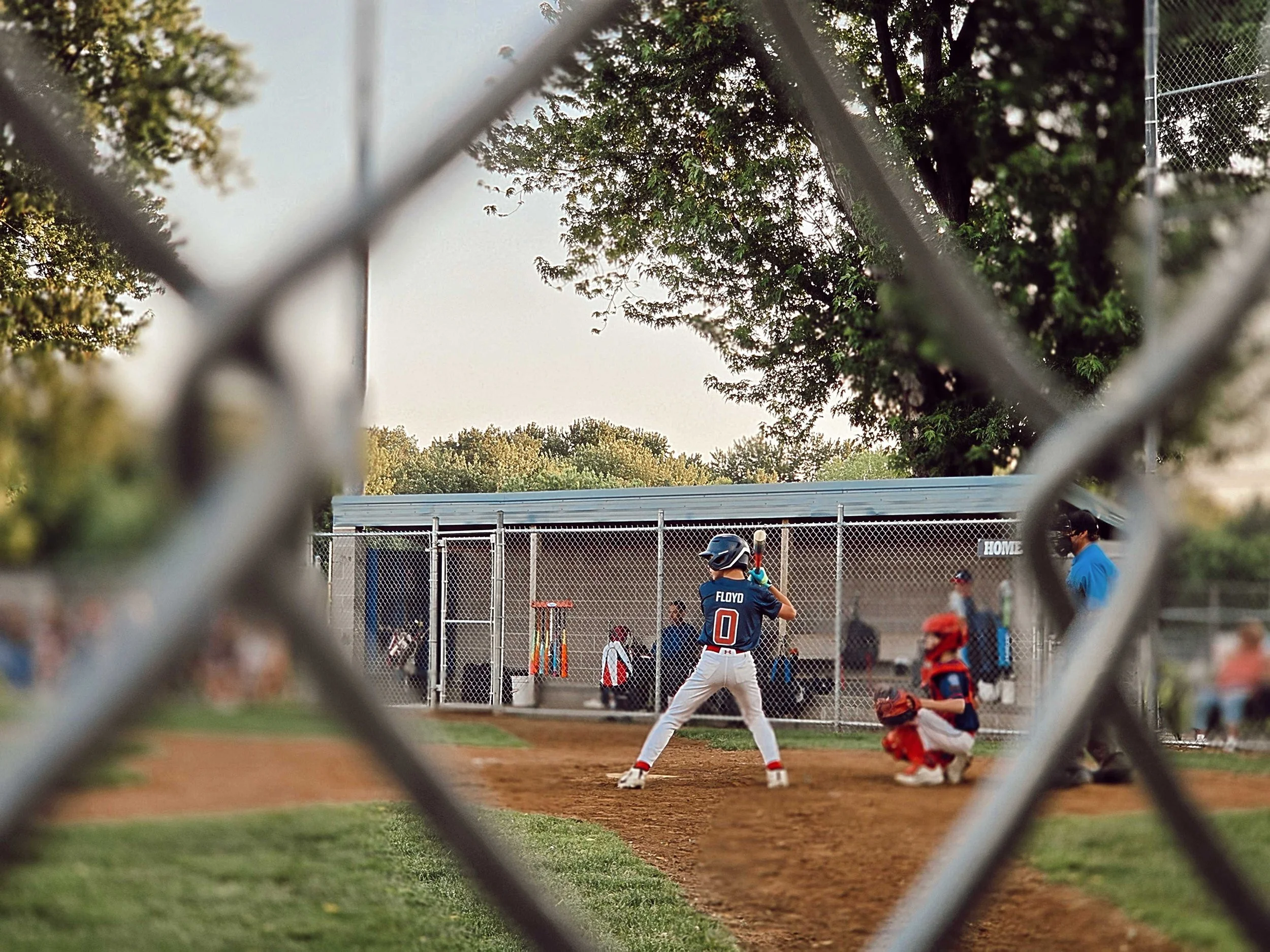
It’s another Tuesday night at the baseball field. The sky above the hills at our neighborhood park is changing from cerulean to amber, and the spring air has begun its rapid descent from cool to cold. Apart from the echo of dugout cheers, the atmosphere is quieting, but I can’t sit still.
I try to embody what I imagine to be the nonchalance bordering on benign neglect of the best ‘90s baseball movie mothers, but clearly I’m failing, because when my friend spots me pacing behind the dull silver bleachers, she says, “You’re walking around like a pitcher’s mom.”
I laugh because she’s right. My middle son, Judah, is at the pitcher’s mound; and as much as I want to watch him pitch, I’m also terrified to watch him pitch.
After each stride, I pause to look out of the corner of my eye (lest I inadvertently channel full nervous energy in his direction). I watch as he takes a deep breath and exhales before moving through the mechanics like a checklist—check for runner, set stance, three-finger grip, load pitch, lift leg, reach back, transfer momentum, release, follow through, ready glove. I don’t exhale my own breath until the pitch lands with a soft thud into the catcher’s mitt. My husband’s encouragement reverberates through the metal fence: “There you go, Judah, just 1-2-3.”
I’m grateful my son has stuck with baseball. Its speed fits well with his easy-going but focused personality, a game where mental acuity matters. Still, I worry—can his 3rd percentile BMI body hang against the 99th percentile kids? Does he feel the pressure of holding the first line of defense? Is he distracted by the sounds of parents and siblings in the stands? Has he built enough muscle memory to support multiple innings at the mound?
My underlying question (worry?) is: If I put myself in his shoes, would I know what to do?
(I would not).
Even at this age—their first year of kid pitch—my husband tells me how versatile pitchers need to be. They should throw fast and hard without compromising accuracy, walking a batter, or worse—hitting a batter. Pitchers need to be defensively ready—able to react quickly to catch a wide range of balls—line drives, pop-flys and grounders. They should back up any infielder to protect against overthrown balls, and like any other defensive position, they’re responsible for getting the ball to the right place at the right time to make the right play. Depending on who’s on base, there are, at any given moment, multiple play options.
I try to explain to my husband just how much this sport baffles me. “In football or basketball, the ball only needs to go in one direction—in the end zone or in the basket,” I say. “In baseball, there are just so many places the ball can go.”
I know that baseball is the classic all-American sport, The Sandlot and all. Maybe for nine-year-old boys, it’s just not that complicated. However, for a middle-aged mom with a sports-free childhood, the situational awareness required from each player leaves me in awe.
In a game with so many possible plays and permutations, how do these kids know exactly what to do?
***
This year, my oldest is heading to middle school. My youngest is in preschool part time, and aside from my occasional (perimenopausal?) 2 a.m. wakeups, we are all sleeping through the night. On the cusp of 40, I’m finally reemerging from the throes of motherhood. But like Rip Van Winkle, I’m waking up to a world whose operating manual reads like inside baseball.
For a minute, I thought I had it figured out: get good grades, go to a good college, get a job, work hard. When I left a dream role to be full-time caregiver to my small children and geriatric dog, the world was still reeling from the pandemic.
Now, we’ve moved full speed into the artificial age, and it’s becoming increasingly clear to me just how much I don’t understand.
In a virtual reality generated by computers, what does it look like to make art?
In a landscape of digitally manipulated images, how do we discern what’s real?
In a society being reshaped by entirely new skillsets, what does it look like to pursue craft?
What does it mean to be grounded in a world of infinite options and unlimited distractions?
What are the rules?
What are the constraints?
What do I do next—on today’s to-do list, in my career, in the next decade of my life?
What game are we even playing right now?
(I only have questions).
***
In the end, my son’s team loses the game, 5-7, but the boys do the sea lion in the outfield anyway (IYKYK). The outcome may not have gone their way, you wouldn’t know it from the exuberance of both the kids and the coaches. My son reaches his highest strike to pitch ratio yet, against the number one team in the league. None of my earlier fears manifest.
This game is evidence of growth mindset in practice, where plays become muscle memory and rules become intuitive understanding, no matter the scoreboard. Even when the results don’t hit, and a line drive off the bat lands straight into an outfielder’s glove, they learn: you stay in the game—this field, this dirt, this pitch, this play.
As baseball bats chime against the metal fence, sideline siblings run circles in the grass, and players run laughing to the snack bar for postgame hot dogs and Gatorades, I finally sit and watch, relieved. I want to bottle up the dreamy ‘90s movie nostalgia of wide open baseball fields, quirky team comradery, and neighborhood summer adventures resurfacing in my own children’s 2020s childhood, even as the last glimmers of a golden, early summer sunset fade, once again, over the baseball field.
My mind flashes back to my college internship, where I stood outside the NASA control room as the Phoenix rover successfully landed on Mars to an explosion of cheers. I wonder how many of those scientists and engineers were once nine-year-old boys on a baseball field with all the same energy and satisfaction, having played—despite their loss—a great game.
I find myself latching onto their vibrant, uncomplicated joy. I want to internalize my son’s ability to play—undaunted and unattached to outcomes. I grasp at the multitudes of meaning orbiting this singular, ordinary moment bounded in time and space.
When I think about my desire for answers to all my midlife, existential questions, I wonder if I’ve missed the entire point.
Amidst a multiverse of possibilities, my son is here, with his dirt-caked cleats and too-big baseball backpack, fully present.
Against the expanse of a now starry night sky, I’m here too, bearing witness to all of it.
Ruth Gyllenhammer is a writer and content director for Coffee + Crumbs. She lives in Southern California with her husband and four children and writes about home and habits in her Substack, Home Making.
Photo by Jennifer Floyd.